Free machine-specific lockout/tagout procedure template
A fill-in LOTO procedure written by a maintenance engineer, with a fully worked example. Word and PDF, free, no sign-up.
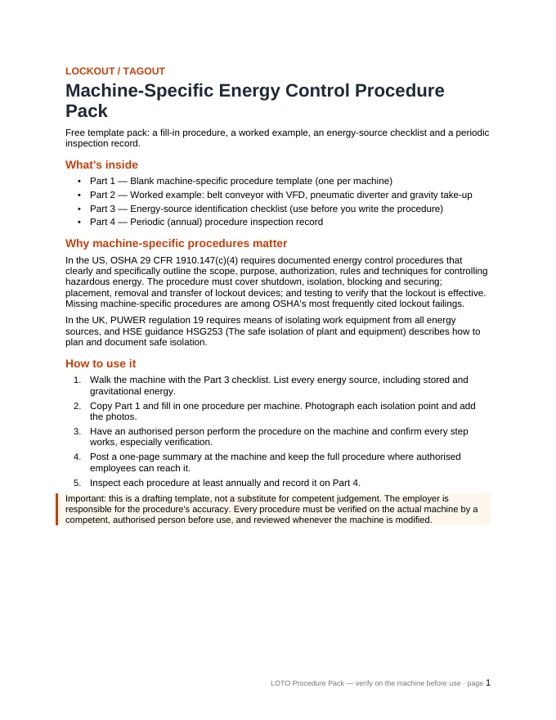
What's in the pack (6 pages):
- A blank machine-specific energy control procedure
- A worked example: belt conveyor with a VFD, pneumatic diverter and gravity take-up
- An energy-source identification checklist
- A periodic (annual) procedure inspection record
Why each machine needs its own procedure
A general lockout policy is not enough. In the US, OSHA 29 CFR 1910.147(c)(4) requires documented procedures that set out, for the equipment concerned, the steps for shutting down, isolating, blocking and securing it. They must also cover placing and removing locks and testing that the lockout works. Missing machine-specific procedures are one of the most frequently cited parts of the lockout standard, which is itself among OSHA's ten most-cited standards every year.
In the UK, PUWER regulation 19 requires suitable means of isolating work equipment from every energy source. HSE guidance HSG253: The safe isolation of plant and equipment explains how to plan and record isolations.
How to write one, step by step
- Walk the machine and list every energy source. This covers electrical power and control supplies, air, hydraulics, gravity, springs and flywheels, heat and process lines. Drive capacitors and accumulators are the ones people miss.
- Identify the isolation point for each. Record the device, where it is and how it takes a lock. Photograph it.
- Say how stored energy is released or restrained. Examples are bleeding air, blocking raised parts, waiting for DC bus discharge and pinning counterweights.
- Write the verification step. Try the start controls, test for absence of voltage with a proven tester, and check that gauges read zero. Then return the controls to off.
- Write the restore sequence. Check tools and people are clear, guards are back on and affected staff are told. Each person removes their own lock.
- Prove it on the machine with an authorised person, then post a summary at the machine.
- Review it at least annually and whenever the machine is modified.
Energy sources people commonly miss
| Source | Where it hides | Typical control |
|---|---|---|
| VFD / servo DC bus | Capacitors stay charged after isolation | Wait for the time on the drive label, then test before touching |
| Separate control supply | UPS, a second feed, or supplies from another panel | Isolate separately and list it in the procedure |
| Trapped air | Cylinders held by closed valves | Dump valve, then cycle manually to vent |
| Hydraulic accumulators | Pressure held after the pump stops | Bleed to tank and confirm on a gauge |
| Gravity | Raised platens, rams, counterweights | Mechanical blocks or pins |
| Remote or automatic start | PLC sequences, timers, upstream machines | Isolate the power, not just the control signal |